PURPOSE AND SCOPE OF THE REGULATION
1. This regulation covers the graduation projects to be prepared by students taking the "ILF411 Graduation Project" course in the 7th and 8th semesters of the 4th year.
2. The purpose of the Graduation Project is for Faculty of Communication students to integrate the knowledge they have acquired in their educational programs into practice and to gain experience in their fields.
3. Students may conduct theoretical or practical work, provided that it is related to the topics of the theoretical and practical courses they have taken in the department.
GENERAL PROVISIONS
4. Each student prepares the Graduation Project under the supervision of a faculty member in the department.
5. Students are responsible for adhering to the rules set forth in this regulation and the work schedule prepared by the responsible faculty members.
6. The work schedule and evaluations prepared by the advisor for the Graduation Project shall be based on the Istanbul Aydın University Academic Calendar.
7. The department head shall oversee and ensure that the graduation project is conducted and evaluated in accordance with these guidelines.
APPLICATION AND RESPONSIBILITIES OF THE ADVISOR
8. Within the scope of the graduation project course, each student works with a faculty member who will advise them throughout the project.
9. In determining the advisor, the suitability of the advisor's area of expertise with the topic of the graduation project, as well as the faculty member's weighting of the student body, are taken into consideration. The course is distributed among the faculty members in the department based on the number of students taking the ILF411 Graduation Project.
10. Student advisors are determined upon the recommendation of the relevant departmental board and the approval of the Dean's Office.
11. Advisors continuously monitor and guide students' work and oversee project reports.
12. The advisor is responsible for submitting all graduation projects to the department head at the end of the academic year.
13. Advisors are accountable to the department head.
PREPARATION OF GRADUATION PROJECTS AND STUDENTS' RESPONSIBILITIES
14. Each department prepares its project in accordance with the program outcomes of the course, in accordance with the rules and principles established by the department board, and in accordance with the criteria for each department listed in the appendix.
15. Student project proposals are evaluated jointly by all advisors and students under the coordination of the department head.
16. Each student is required to submit at least two project reports to their advisors within the dates specified in the work calendar.
EVALUATION OF PROJECTS
17. Each department evaluates its project in accordance with the program outcomes of the course, in accordance with the rules and principles established by the department board, and in accordance with the criteria for each department listed in the appendix.
18. In theoretical studies, faculty advisors are required to perform a similarity assessment using Turnitin. Works with a plagiarism rate exceeding 20% will be given an additional time for correction. Projects that fail to receive an originality report through Turnitin and whose similarity rate exceeds the accepted threshold despite undergoing the revision process will be disqualified and deemed unsuccessful.
19. Graduation Projects are evaluated by a jury of at least three faculty members, chaired by the department head, following the student's presentation.
20. If deemed necessary, a jury member from outside the University may be appointed with the recommendation of the Department Council and approval of the Dean's Office.
21. In cases where formal education cannot be conducted (during pandemic periods), presentations will be evaluated in virtual meeting environments (Zoom, Microsoft Teams, Adobe Connect, etc.) with the participation of all evaluators and students. Students will participate in virtual presentations with their presentation cameras and microphones turned on.
22. In this evaluation, the jury evaluates the project based on its subject and field, including formal and content integrity, original approach, and analytical approach.
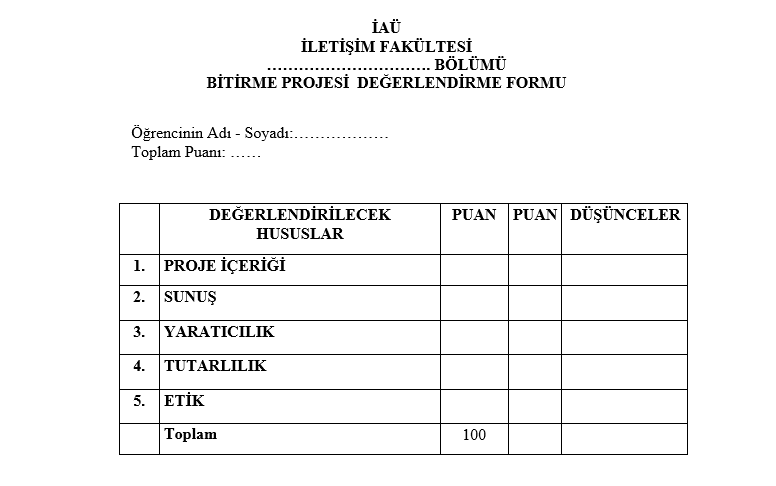
23. At the end of the presentation, the jury members will complete the evaluation form below based on the relevant headings detailed by each department based on their program outcomes, and will award the student a grade.
The Graduation Project Success Grade is evaluated according to the Istanbul Aydın University Grading Evaluation System Guidelines.
In cases where it is necessary due to a natural disaster, pandemic, adverse weather conditions, or unforeseen circumstances, the Department Head may make changes to the graduation project schedule. Any such changes to the schedule in case of necessity are notified to the Dean's Office and communicated to the students.
The Graduation Project Evaluation Form will be administered as described below.
PREPARATION OF JOURNALISM CAPSTONE PROJECTS AND STUDENT RESPONSIBILITIES
In line with the theoretical and practical training received over four years, students in the Department of Journalism will either conduct an academic research study or produce content for the department’s application platforms.
a) Written Research Project: Together with their project advisor, students select a research topic related to subjects studied over four years—such as journalism, news, digital journalism, or specialized areas of journalism. This project aims to develop theoretical and critical perspectives, and the use of a research method is mandatory.
The ILF 411 Capstone Project course is carried out under the supervision and coordination of the relevant faculty members offering the course. Work conducted within the scope of the Written Research Project must be submitted to the supervising faculty member, with signature, at least one week before the start of the final exam period.
All written-track project work and work prepared for application platforms must be submitted digitally to the supervising faculty member before the printed copies are delivered.
For Written Research Projects, supervising faculty members will determine the similarity rate using Turnitin plagiarism-detection software. Works whose similarity rate exceeds the limit accepted and announced by the advisors will be granted a short period for revision. Works that cannot obtain an originality report from Turnitin, or that remain above the accepted limit despite revisions, will be excluded from evaluation and deemed unsuccessful.
Students who choose the research project present their capstone projects before a three-member jury. Students who pass submit two bound copies of their projects—signed “Successful” by their advisors—to the Department Chair. Graduation procedures will not be completed for students who fail to submit their projects.
Capstone projects will be short research papers of no more than 60 pages and must include the following sections: Table of Contents, Introduction, Chapters/Sections of the Study, Conclusion, References.
b) Producing Content for Application Platforms: The Department of Journalism has application platforms where students put theory into practice: İstanbul Aydın News Agency (İAHA), Göz Magazine, and İF Haber Newspaper. Students who opt to work in these units are required, under their advisor’s supervision throughout the semester, to produce texts such as news reports, features, and interviews.
Students preparing content for application platforms choose one of the platforms under the umbrella of İstanbul Aydın News Agency (İAHA)—Göz Magazine or İF Haber Newspaper—obtain topic approval from the coordination of the relevant unit, and begin work.
Until completion, the process is monitored by the İAHA Coordinator and the Department Chair. Before the final presentation, students must present their ideas to their advisors through interim presentations within the dates specified in the work schedule.
Students ensure supervision of their work through weekly or monthly briefing meetings. After the end-of-term work is found successful, it is published by the relevant units.
EVALUATION OF PROJECTS
Projects are evaluated by a jury of at least three members, to be announced by the Department Chair, together with the course instructor. Students present their projects to the jury during the final period in accordance with this procedure.
a. On the scheduled dates, students deliver 15-minute presentations before the jury in order. The presentation must fully include an abstract of the project and details of the work carried out.
b. Regardless of face-to-face or online delivery, after the presentations—and in the absence of the students—each jury member records marks on the prepared evaluation form. All marks are compiled to assign a single common grade to each project.
Within the 15-minute time slots, presentations must also cover the project’s motivation, a summary of the research, technical details of the work conducted, and, where possible, the results obtained.
Regardless of face-to-face or online delivery, after the presentations—and in the absence of the students—each jury member records marks on the prepared evaluation form. All marks are compiled to assign a single common grade to each project.
Throughout the presentations, the evaluation jury assesses whether the work is correctly understood, whether adequate research has been conducted, and the extent to which the study is supported by the learning outcomes.
The jury evaluates the work multidimensionally within the criteria of formal properties, compliance with ethical rules, originality, coherence of form and content, originality of approach, and analytical approach.
Written Research Projects are evaluated as follows:
Formal Properties: Cover page; table of contents; list of figures (if any); font; font size; paragraph and page layout — 10 points
Content Properties: Research Method (the method must be explained; the criteria for sampling must be stated) — 30 points
Theoretical Research: (Every study must include a theoretical background) — 40 points
References: In addition to electronic sources, printed sources (books, reports, articles, etc.) must be used — 20 points
Students working in the application platforms must submit a regular report every two weeks to the İAHA Coordinator and the Department of Journalism Chair. Their news pieces must be published in one of the application platforms. The aim is to prepare students for the sector and to ensure they build a personal work portfolio.
News items will be evaluated as follows:
Topic of the news: 20 points
Compliance with news-writing conventions: 50 points
Compliance with spelling rules: 30 points