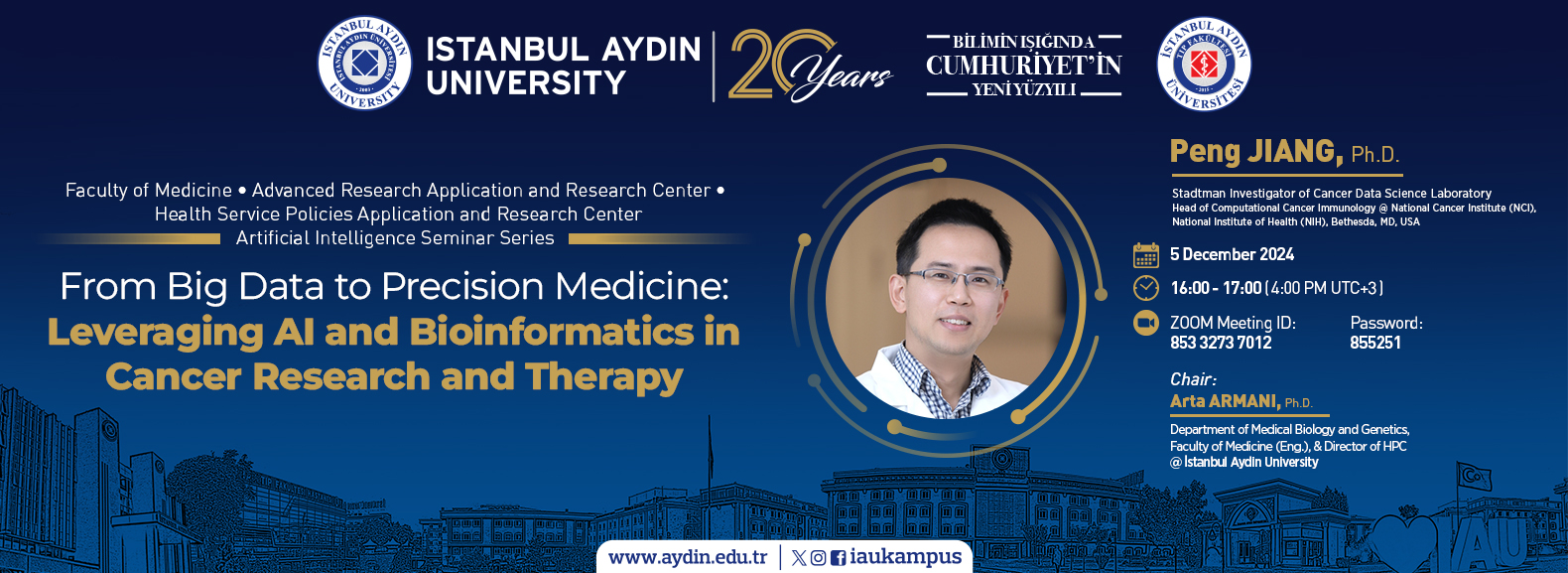
WEBINAR on the Use of Artificial Intelligence and Bioinformatics in Cancer Research by Dr. Peng JIANG from the National Institutes of Health (NIH)Istanbul Aydın University hosted an internationally prestigious event on the latest developments in medicine, engineering, and artificial intelligence, bringing together the academic community on December 5, 2024, through a webinar titled 'From Big Data to Precision Medicine: Leveraging AI and Bioinformatics in Cancer Research and Therapy.' The event was organized in collaboration with the Faculty of Medicine, Advanced Research Center, and Health Services Policies Implementation and Research Center of Istanbul Aydın University. Valuable insights were provided to the participants on how artificial intelligence and bioinformatics technologies could revolutionize cancer research.
The webinar was moderated by Dr. Arta ARMANI, an esteemed faculty member at Istanbul Aydın University. Dr. ARMANI highlighted the purpose and significance of the event, emphasizing the transformative contributions of artificial intelligence to the healthcare sector. She pointed out that big data and AI in cancer research could personalize treatment processes, making them more effective. She also noted that this webinar was the second event organized as part of Istanbul Aydın University's Artificial Intelligence Seminar Series.
Renowned Dr. Peng JIANG, who participated from the National Cancer Institute (NCI) at the National Institutes of Health (NIH), shared insights in a presentation that was particularly valuable for students. Dr. JIANG emphasized the revolutionary potential of artificial intelligence in cancer treatment and elaborated on how big data and bioinformatics modeling techniques could be effectively utilized.
Dr. JIANG explained that AI has become a crucial tool in cancer therapy, particularly in achieving a more accurate understanding of tumor biology using FIBP binders. He introduced the SpaCET (Spatial Cellular Estimator for Tumor) model and stressed the importance of analyzing the cellular structure of tumors and intercellular interactions. He pointed out that cell-to-cell interactions at tumor-immune boundaries play a critical role, and AI has great potential in overcoming these challenges.
In his explanation of the Tres Model, Dr. JIANG discussed the identification of genetic markers in tumor-resistant T cells to analyze immune suppression. He noted that this model could be an important tool in developing new therapeutic approaches for cancer treatment.
Additionally, Dr. JIANG highlighted that the FIBP gene is a negative marker that weakens T cells' ability to fight cancer. When FIBP was deleted in mice using CRISPR technology, the mice were observed to control tumors more effectively. These findings could provide new therapeutic targets for cancer immunotherapies.
At the end of his presentation, Dr. JIANG discussed the future of AI in cancer treatment and its potential to overcome the limitations of current treatment methods, sharing promising developments in this field.
The webinar concluded with questions from the participants and active engagement. Dr. ARMANI thanked Dr. JIANG for accepting the invitation and sharing his valuable presentation with the audience, expressing her gratitude to the participants for their interest and contributions to the event.